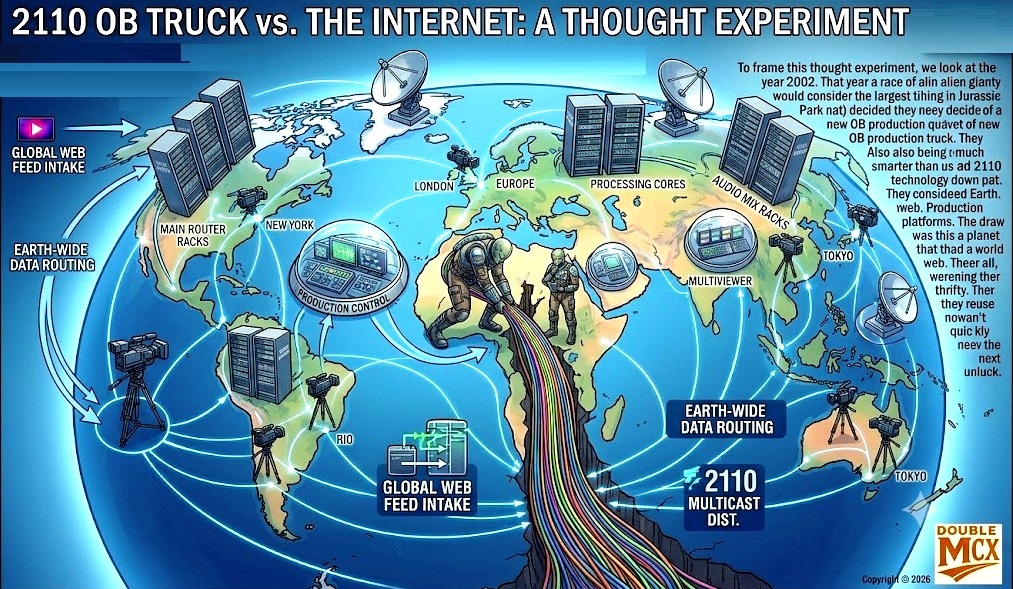

2110 OB Truck vs. The Internet: A Thought Experiment
To frame this thought experiment, we look at the year 2002. That year a race of alien giants (they would consider the largest thing in Jurassic Park a nat) decided that they needed their equivalent of a new OB production truck. They also being much smarter than us had 2110 technology down pat. They considered Earth. Why? Because that is what they often used planets for. Production platforms. The big draw was that this was a planet that had a world wide web. These giants, after all, were nothing if thrifty. They would reuse the infrastructure already here.
Luckily for humans they ran a couple tests and realized our web wasn't quite what they needed. They moved on to the next unlucky planet.
By early 2002, the global internet was still largely operating in the high-gigabit realm, with total backbone capacity often falling short of the sustained, reliable, non-blocking 1–2 Terabits per second (Tbps) required for your giant, Earth-sized "production truck." It wasn't until the 2003–2005 window that the global infrastructure matured enough to theoretically sustain that kind of load. If your giants had attempted this before 2003, they would have faced catastrophic packet loss, insufficient throughput, and the kind of latency that makes live broadcast impossible.
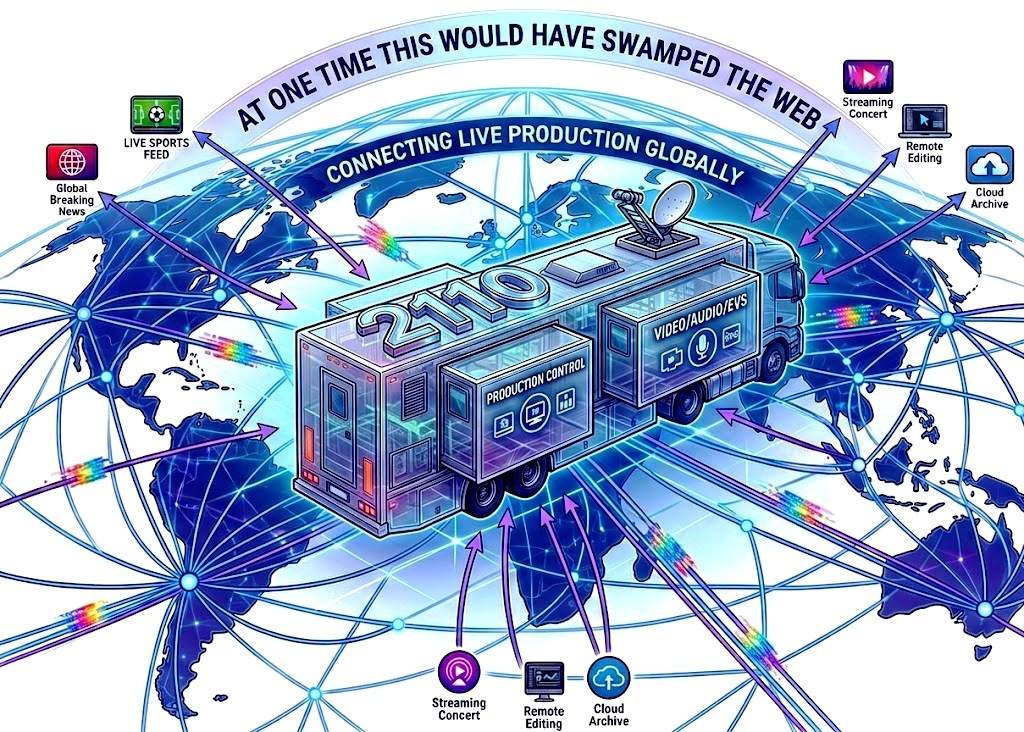
1. Bandwidth Calculation: The Production Truck
In a modern professional broadcast environment, sources (cameras, playback servers, graphics) and receivers (monitors, recorders, multiviewers) typically operate using SMPTE ST 2110 (IP-based video transport).
- Standard Signal: A single uncompressed 4K (UHD) video stream at 60fps typically requires approximately 12 Gbps of bandwidth.
- The Math: 36 Sources: 36 * 12 Gbps = 432 Gbps.
- 100 Receivers: In a spine-leaf architecture with redundancy (where each signal is duplicated across two parallel networks for hitless switching), the switching fabric must handle not just the primary traffic but the duplicated flows.
- Aggregate Load: In a non-blocking spine-leaf design, the total fabric capacity usually needs to accommodate the sum of all active video flows, plus significant overhead for control signals, audio (AES67), and metadata.
- Estimated Total: A production truck with this density would realistically require a switching fabric capable of ~1 to 2 Terabits per second (Tbps) to account for non-blocking performance and the 1:1 redundancy required for professional reliability.
2. Historical Context: When did the Internet match this?
Comparing a local "closed" network (the truck) to the "global" internet is complex because internet traffic is measured as throughput (data moving across the backbone), while your truck is a switching fabric capacity calculation.
However, we can look at when the global internet backbone traffic reached roughly 1 to 2 Terabits per second (Tbps) of sustained capacity.
| Era | Global Internet Traffic Metric |
|---|---|
| Late 1990s | The entire backbone of the internet was measured in megabits (Mbps) and low gigabits (Gbps). |
| 2003–2005 | Total global internet traffic began consistently crossing the 1 Tbps threshold during peak usage times. |
| 2026 (Today) | Total internet traffic is measured in the range of thousands of Terabits per second (Petabits/s). |
The Verdict
The total sustained capacity of a single high-end, redundant, non-blocking broadcast production network today (approx. 1–2 Tbps) is roughly equivalent to the total global internet backbone capacity in the 2003–2005 era.
It is a striking illustration of how professional broadcast environments have been "living in the future" for years—the amount of data moving inside a single truck for a live broadcast is equivalent to the capacity that the entire world’s internet infrastructure was struggling to provide just two decades ago.
Note: This comparison uses total backbone capacity (the "pipes" of the internet) as a proxy for your truck's switching fabric capacity. The "internet" does not have a single "bandwidth" number like a local network does, but this 2003–2005 window reflects when the infrastructure finally caught up to the demands of a high-end, 36-source 4K production facility.